Übersetzung in VorbereitungDer Inhalt dieser Seite befindet sich noch in der manuellen Übersetzung. Wir zeigen vorübergehend die englische Version an, um technische Fehler zu vermeiden. Die Menüs und das Formular sind bereits auf Deutsch.
Costa del Sol: Villas, Pools, Air-con, EVs

Solar Panels on the Costa del Sol

The Costa del Sol is one of the strongest areas in Spain for solar panels, but not every home needs the same system. We provide independent guidance to help you find the right setup.

Solar Panels on the Costa del Sol

Kurzantwort

The Costa del Sol is one of the strongest areas in Spain for solar panels, but not every home needs the same system. Die optimale Konfiguration hängt von Ihrem tatsächlichen Verbrauch, der Dachausrichtung, dem Batteriebedarf und der Wahl des richtigen Einspeisetarifs ab.

Is solar worth it on the Costa del Sol?

The Costa del Sol has very strong solar conditions compared with northern Europe, but the financial result still depends on the property’s actual consumption, roof, battery choice and electricity tariff. A typical residential installation will generate substantially more electricity here than in northern Europe, providing a potentially faster payback period under the right conditions.

However, solar is highly consumption-dependent. It represents an excellent investment if your property has high electricity bills, daytime occupancy (families, remote workers), pool pumps running during peak sun hours, summer air conditioning, or electric vehicle (EV) charging.

Solar for villas with pools

Villas with swimming pools are the ideal candidate for solar power. A standard pool pump runs for 6 to 8 hours daily during the summer, consuming between 750W and 1,500W continuously. By running the pool filtration cycle exclusively during peak solar generation hours (typically 10:00 to 16:00), villa owners can directly consume 100% of their generated solar power, maximising the self-consumption ratio and avoiding expensive grid imports.

Solar for holiday rentals

For holiday rentals, consumption patterns are highly seasonal. Tourists run air conditioning units at maximum capacity during the hottest summer months, which matches peak solar production perfectly. However, during the winter, usage drops off. Sizing a system for a holiday rental requires finding a balance that covers summer peaks without exporting excessive, uncompensated power during quiet winter months.

Solar for apartments and communities

Apartment owners in urbanisations can benefit from shared solar installations (autoconsumo colectivo). Under Spanish law, solar energy generated on a community roof can be shared among neighbours within a 2,000-metre radius. This allows apartment owners to reduce their electricity bills without needing individual roof space, though it requires community of owners (Comunidad de Propietarios) approval.

Solar in Marbella vs Nerja vs inland Málaga

Geography impacts solar performance. Marbella and the western Costa del Sol experience coastal mist that can slightly delay morning generation, and salt-laden sea air requires high-durability anodised aluminium mounts. Inland Málaga areas like Alhaurín or Coín experience intense summer heat, which can reduce panel output due to temperature coefficients. Nerja and the eastern coast have excellent clarity but traditional village homes must handle roof placement aesthetics.

What export compensation means for oversized systems

In Spain, export compensation (compensación de excedentes) is legally capped. Your supplier will only credit you for exported energy up to the value of the active energy you imported during that billing period. Sizing a system to be excessively large leads to a low return on investment, as any excess generation beyond the cap is exported to the grid for free with no credit.
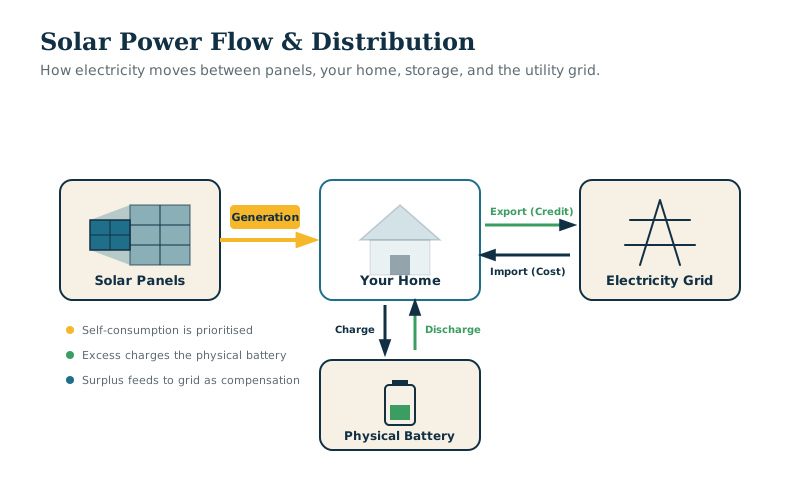
Diagram showing solar panels powering a home, charging a battery and exporting surplus energy to the grid

When a physical battery makes sense

A physical battery makes sense for properties with high night-time consumption, such as running ducted air conditioning overnight, heating pools in spring/autumn, or running heavy appliances after dark. It is also beneficial if the local grid suffers from frequent outages, as a hybrid inverter with a backup gateway can keep essential circuits live during blackouts.

When a virtual battery may be better

A virtual battery tariff can sometimes be more cost-effective than a physical battery, especially for holiday homes that sit empty for parts of the year. Instead of storing physical energy in a battery, the supplier converts excess solar generation into a cash balance (in euros) to offset future bills or even a second property. However, the supplier's fees, credit rules, and import prices must be checked carefully.

Common quote mistakes on the Costa del Sol

Common errors include accepting a quote that doesn't explicitly state the manufacturer and model of the panels and inverter, failing to confirm who pays for the municipal work permits (licencia de obra), and neglecting to check if the installer registers the installation with the Junta de Andalucía to enable export credits. Always verify these details before signing.

Frequently Asked Questions

Are solar panels worth it on the Costa del Sol?
Solar panels are highly worth it on the Costa del Sol due to the exceptional solar radiation of over 300 sunny days per year. However, the exact return on investment depends on your daytime consumption, current electricity tariff, and whether you optimize your usage pattern. To make solar panels financially viable, you should size the system to match your actual baseline energy usage rather than overbuilding the array. A sensible next step is to perform a detailed suitability check of your roof space and electricity bills.
Do solar panels work well in winter in southern Spain?
Yes, solar panels work very well during winter on the Costa del Sol because daytime winter sun hours remain strong and temperatures are optimal for panel performance. While total daily energy yield is lower than in mid-summer due to shorter days and a lower sun angle, winter generation is often sufficient to cover baseline house loads. However, heavy heating demands from heat pumps or pool heaters may still require grid imports. We recommend adjusting your consumption timers to run heating devices during midday sun hours.
Can solar panels power air conditioning in summer?
Yes, solar panels can easily power air conditioning in the summer because peak solar production aligns perfectly with hot afternoon air conditioning demands. Since cooling is one of the largest seasonal power costs in Spain, running your AC directly from solar panels saves significant import costs. However, running ducted AC systems overnight will exhaust your daytime generation unless you install a physical battery or utilize a virtual battery contract. A practical next step is setting your AC temperature to cool the house down before sunset.
Can solar panels run a pool pump on the Costa del Sol?
Yes, solar panels are highly effective for running pool filtration pumps because filtration cycles are flexible and can be scheduled entirely during daylight hours. A standard pool pump draws 750W to 1,500W, representing a large portion of a villa's summer electricity bill. By using timer controls to run the pump only between 10:00 and 16:00, you can achieve 100% self-consumption of this power. We recommend scheduling pool timers to run sequentially during peak solar generation.
Can holiday homes benefit from solar panels on the Costa del Sol?
Yes, holiday homes can benefit significantly from solar panels, particularly when combined with a virtual battery contract to store surplus energy value when the property is empty. During months of low occupancy, the panels continue generating power and exporting it to the grid, building up a euro balance. This balance can then be used to offset bills during high-occupancy summer months or even cover a second property in Spain under the same supplier. We recommend reviewing virtual battery terms before choosing a system.
Do solar panels work during a power cut on the Costa del Sol?
No, standard grid-tied solar installations do not work during a power cut for safety reasons to prevent feeding electricity into the grid while technicians are working on lines. To run your home during a blackout, you must install a hybrid inverter and an automatic transfer switch or backup box. These components isolate your system from the grid and redirect battery power to critical circuits like lights and internet. We recommend assessing whether grid reliability in your specific area justifies the extra cost of backup hardware.
What happens if I export more solar than I use?
In Spain, standard export compensation (compensación de excedentes) is financially capped, meaning your supplier will only credit you up to the value of the active energy you imported during that billing cycle. Any additional surplus energy you feed into the grid is lost unless you contract a virtual battery plan. A virtual battery stores your excess export credits as a cash balance in euros, allowing you to reduce your entire bill, including standing charges, to zero. We recommend choosing a tariff that offers a virtual battery if your export is high.
Should I choose a bigger solar system or a better tariff?
You should prioritize getting the right tariff first, as an oversized system will yield diminishing returns due to Spain's export compensation caps. A system that is too large will export excess electricity for free if you are on a poor tariff, whereas a properly sized system on an optimised tariff with virtual battery storage will maximize your financial savings. We recommend having your current electricity bills analyzed to size your system accurately before signing a contract.
What should I check before accepting a solar quote on the Costa del Sol?
You should check that the quote is fully itemised, lists the exact brands and models of panels and inverters, and explicitly includes all registration fees (boletín/CIE) and town hall permits. Be cautious of quotes that lump all costs together or promise guaranteed grants, as subsidies in Andalusia are heavily backlogged and subject to strict criteria. A sensible next step is to request a free independent quote audit to identify hidden exclusions.
How long does it take to install solar panels on the Costa del Sol?
The physical installation of residential solar panels on the Costa del Sol typically takes only one to two days. However, obtaining municipal building permits (declaración responsable) and the final electrical registration (boletín/CIE) can add between four and eight weeks. You must wait until the regional distributor notifies your electricity supplier before export compensation begins. We recommend ensuring your installer handles all administrative paperwork.