
Übersetzung in VorbereitungDer Inhalt dieser Seite befindet sich noch in der manuellen Übersetzung. Wir zeigen vorübergehend die englische Version an, um technische Fehler zu vermeiden. Die Menüs und das Formular sind bereits auf Deutsch.
Spain Solar Export & Billing Advice

Solar Export Tariffs in Spain

Last reviewed: June 2026

Understanding how solar export compensation, index-linked rates, and virtual battery contracts function in Spain is essential for maximising your return. Supplier rates, export compensation terms and virtual battery conditions change frequently — always compare current tariff conditions before switching or signing a solar quote.

Kurzantwort

Understanding how solar export compensation, index-linked rates, and virtual battery contracts function in Spain is essential for maximising your return. Die optimale Konfiguration hängt von Ihrem tatsächlichen Verbrauch, der Dachausrichtung, dem Batteriebedarf und der Wahl des richtigen Einspeisetarifs ab.

What is solar export compensation?

In Spain, solar export compensation (compensación de excedentes) allows you to offset your electricity bills by selling surplus solar energy back to the grid. When your panels generate more power than your home is consuming, the excess flows into the distribution network.

It is critical to understand that this is not a one-for-one “net metering” system. You do not get paid cash; instead, your supplier applies a financial credit to your bill in euros. Under standard regulations, this credit can only reduce the “active energy” portion of your bill to €0, leaving you to pay fixed standing charges (potencia and taxes).
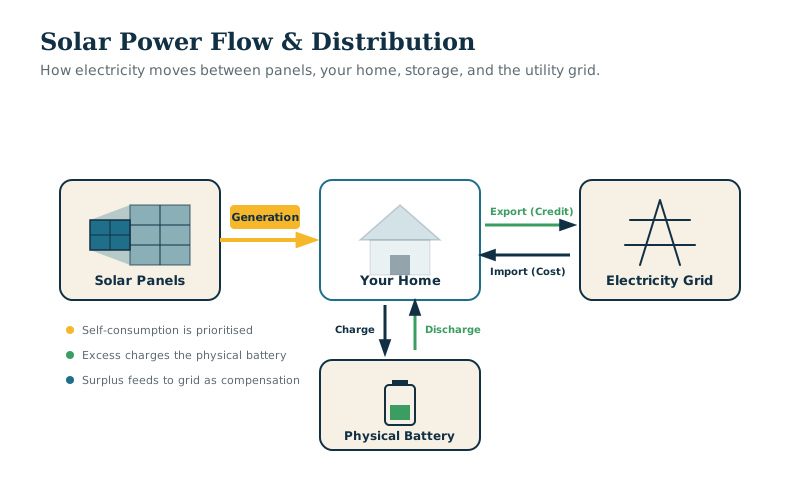
Diagram showing solar panels powering a home, charging a battery and exporting surplus energy to the grid

Compare the whole tariff, not just the export rate

A common mistake is choosing an energy plan solely because it offers a high export rate (e.g., €0.10/kWh exported). If that same plan charges a high import rate (e.g., €0.28/kWh imported), you will likely lose money because most homes still import electricity during the evenings and nights.

When evaluating solar tariffs, you must look at:

  • The import rate (cost of energy you buy from the grid).
  • The export compensation rate (value of energy you export).
  • The cost of contracted power (potencia contratada), which represents the fixed daily fee.
  • Any standing monthly management fees or hidden administration surcharges.

Fixed vs. Indexed export compensation

There are two primary models for pricing exported solar energy in Spain:

  • Fixed Export: The supplier pays a constant, pre-agreed rate (e.g. €0.08/kWh) for every unit of exported solar energy, regardless of the time of day. This is simple and predictable.
  • Indexed Export: The compensation fluctuates hour-by-hour based on the Spanish wholesale electricity market (OMIE). While this can align with market values, during peak solar generation hours (12:00 to 16:00), grid supply is high, which often drives index-linked export rates down to €0.02/kWh or even zero.

How virtual batteries (batería virtual) work

To bypass the legal restriction where export credits can only offset the active energy charges, many suppliers now offer a “virtual battery” (or cloud storage account).

Under this contract, all exported solar energy is converted into a euro balance. This balance is used first to offset your active energy charges to €0. Any remaining surplus credits are stored in your virtual account and can be used to offset:

  • Fixed charges (potencia and meter rent) on the primary property.
  • Taxes (electricity tax and IVA).
  • Bills for a second property registered with the same supplier (e.g., a holiday home or apartment).
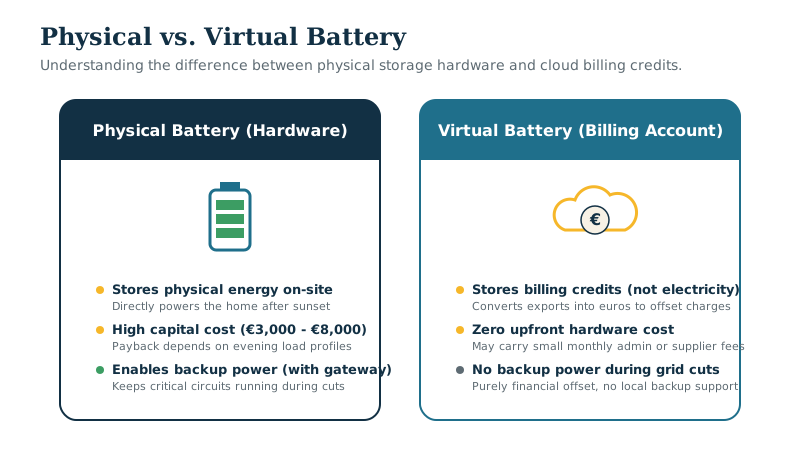
Comparison diagram showing the difference between a physical solar battery and a virtual battery tariff

Why solar bills can remain surprisingly high

If you have installed solar panels but your electricity bill is still high, it is usually caused by one of three issues:

  1. Export compensation is not active: Your system must be legalised by the industry delegation and recognized by your distributor before credits appear on your bill. This process can take 1 to 3 months.
  2. High standing power costs (potencia): If you have not optimized your contracted power, you will pay high fixed charges even if you import zero energy.
  3. Wrong tariff: You are stuck on a standard tariff with poor solar terms.
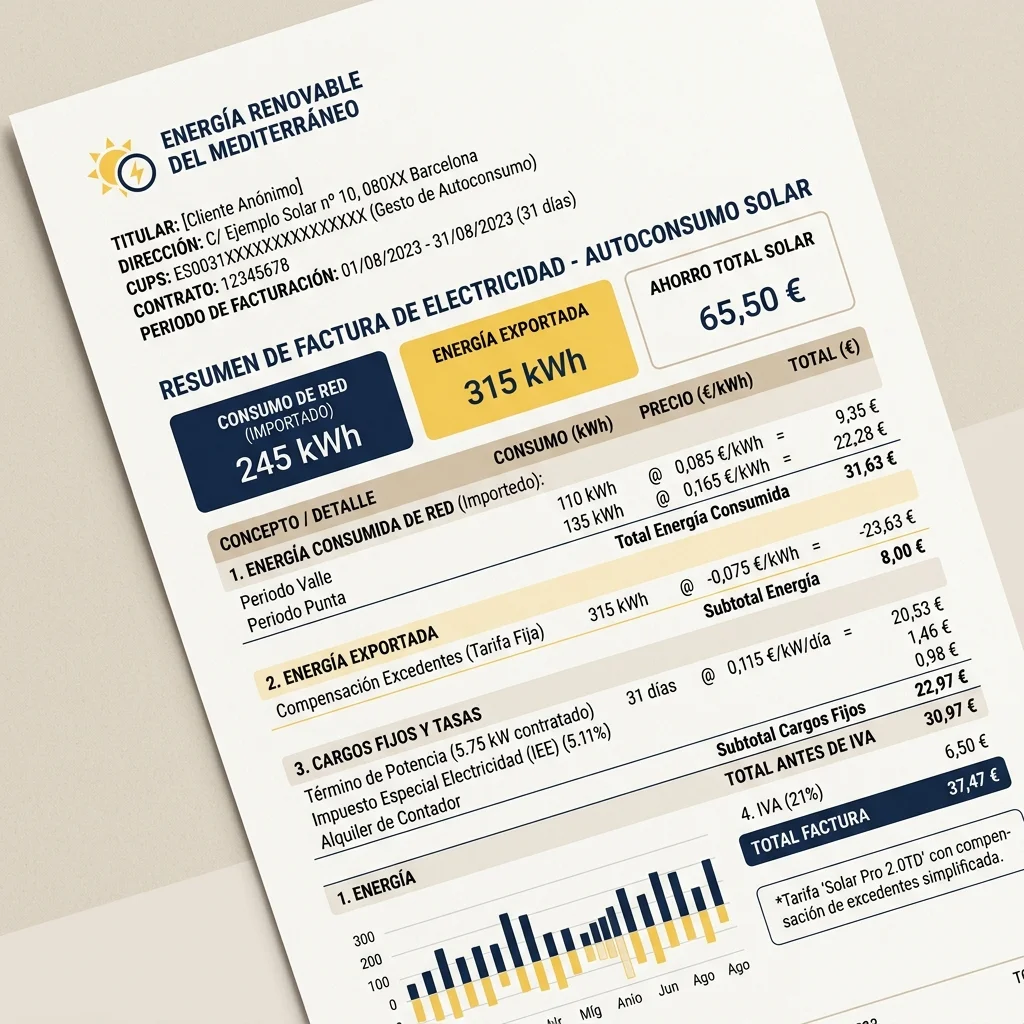
Anonymised Spanish electricity bill mockup showing solar export compensation and tariff charges

Need help checking your solar export tariff?

Costa Solar Guide explains how export compensation, indexed export and virtual battery offers work. If you want a full electricity bill and tariff comparison after solar installation, our partner service weSwitchSpain can help review your current supplier and available alternatives.

Costa Solar Guide focuses on solar advice and installer introductions. weSwitchSpain focuses on electricity tariff comparison and switching support.

Frequently Asked Questions

What is solar export compensation in Spain?
Solar export compensation (compensación de excedentes) is a billing mechanism in Spain that allows you to receive financial credits on your electricity bill for excess solar energy you feed back into the grid. These credits offset the cost of the electricity you import when your panels are not producing. However, this is not a cash payout; it only offsets active energy imports unless you use a virtual battery plan. A sensible next step is ensuring your installer registers your CIE certificate to enable export billing.
Is export compensation the same as net metering?
No, export compensation is not net metering, as you do not exchange electricity on a simple one-to-one basis. Your supplier sells you grid electricity at an import rate (e.g. €0.18/kWh) and buys your surplus solar at a lower export rate (e.g. €0.08/kWh). Additionally, standard compensation only reduces your active energy charges to €0, leaving you to pay standing charges. We recommend choosing a tariff that balances a low import price with a reasonable export rate.
What is a virtual battery?
A virtual battery is a cloud-based billing arrangement offered by commercial energy suppliers in Spain, not a physical storage device. It allows you to convert your excess exported solar electricity into a financial credit (in euros) to reduce future electricity bills to zero, including standing charges. However, virtual batteries are not always free to run, as some suppliers charge monthly management fees or offer poorer import rates. To determine if this fits your needs, review different supplier tariff structures and their respective virtual battery conditions.
Can export credits reduce fixed charges?
Yes, but only if you contract a virtual battery plan with your supplier, as standard export compensation only offsets active energy import charges. A virtual battery stores your surplus export credits as a cash balance in euros, which can be applied to reduce the daily power fees (potencia), taxes, and meter rents. Some plans also allow you to use this balance to offset bills at a secondary property in Spain. We recommend comparing virtual battery supplier terms before switching.
What happens if the export price is negative?
If you are on an indexed export tariff, negative wholesale prices mean the credit value of your exported solar energy drops to zero or near-zero during peak midday sun hours. This occurs when high solar generation across Spain exceeds grid demand. If you have a large system that exports heavily during the day, a fixed-rate export tariff is usually safer than an indexed plan. A practical next step is checking whether your tariff has a minimum export floor price.
Is indexed export better than fixed export?
An indexed export tariff can be beneficial if you consume most of your solar energy directly and export very little, or if market rates are high. However, during peak solar generation hours (12:00 to 16:00), high grid supply often drives index-linked export rates down to €0.02/kWh or even zero. A fixed export rate (e.g., €0.08/kWh) offers stability and is generally better for systems without physical batteries. We recommend comparing your export volume against historical market rates.
Why is my exported solar not showing on my bill?
This delay is usually because your system has not been fully registered with the regional industry delegation or recognized by your distributor. The legalisation process can take one to three months to complete. Until the distributor updates your CUPS file and notifies your supplier, you will not receive credits for exported energy. We recommend contacting your installer to confirm that the Certificate of Electrical Installation (CIE) has been successfully uploaded and approved.
Can I change supplier after installing solar?
Yes, you can change your electricity supplier at any time after installing solar panels in Spain without interrupting your power supply. Your new supplier will request your historical consumption data from the distributor using your CUPS number. However, you should check that the new supplier supports solar export compensation and offers virtual battery terms that match your generation profile. A sensible next step is performing a bill audit to find the best available tariff.
Does the virtual battery credit expire?
This depends on the supplier. Some suppliers allow credits to accumulate indefinitely and roll over month-to-month, while others reset the balance at the end of the calendar year. Always check the contract terms carefully.
Which suppliers offer the best solar export tariffs in Spain?
The best supplier for solar customers changes frequently as tariff structures and virtual battery terms are updated. Some suppliers offer strong virtual battery features, fixed export compensation or favourable import rates for solar homes, but the right choice depends on your import usage, export volume, standing fees and contract terms. A practical next step is performing a comparative bill audit using your actual usage data before committing to a tariff.