
Snabbsvar
Before accepting a solar quotation in Spain, use this checklist to verify that you are getting high-quality components, complete legalisation paperwork, and realistic tariff terms. Den optimala konfigurationen beror på din faktiska förbrukning, takorientering, batteribehov och att välja rätt exportelavtal.
Why solar quotes in Spain can be difficult to compare
When evaluating solar energy in Spain, many property owners receive multiple quotations that look completely different. One installer might quote for a 5 kWp system with 10 panels, while another quotes for a 4.5 kWp system with 12 panels, and the pricing can vary by thousands of euros.
Comparing quotations solely on the total price or the number of panels is a common mistake. Quotes often hide critical details such as the inverter capacity, panel temperature coefficients, and whether administrative fees for the regional building declaration (Declaración Responsable) and final registration (boletín/CIE) are included. Using a structured checklist ensures you are comparing like-for-like engineering specifications, legal paperwork, and real warranties.
The 12 things every solar quote should show
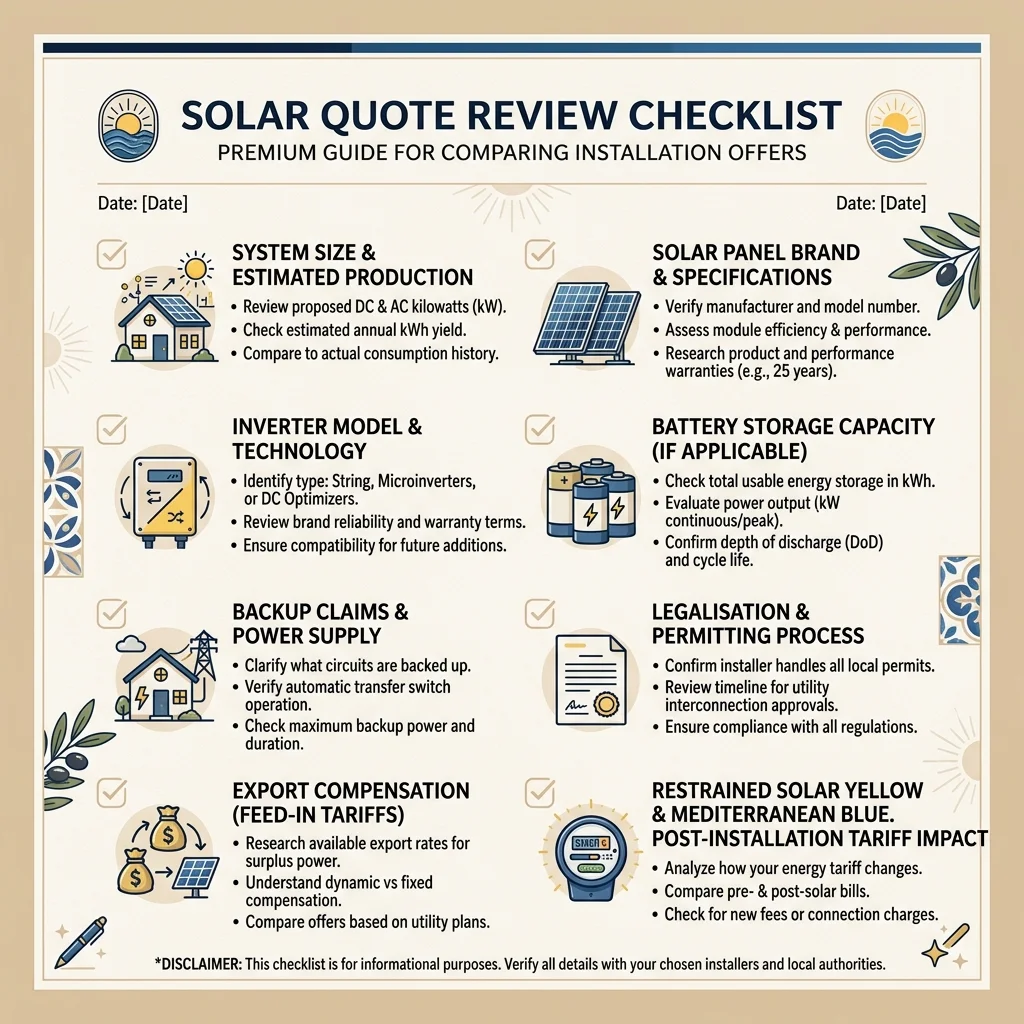
Before signing any contract or paying a deposit, verify that your quotation explicitly itemises these twelve critical details:
The quote must specify the exact brand, model, and peak wattage (e.g., JinkoSolar Tiger Neo 440W). Do not accept generic descriptions like “Tier 1 monocrystalline panels.”
The inverter is the heart of your system. The quote must state the brand and model (e.g., Huawei SUN2000-5KTL-L1). Check if it is a single-phase or three-phase model, matching your home’s grid connection.
If a battery is included, check the nominal capacity and the usable capacity (how much energy you can actually draw). For example, lithium batteries (LiFePO4) typically allow 90% depth of discharge.
Ensure the quote specifies the structure brand (e.g., Sunfer) and material (aluminium/stainless steel). The installer should outline how they will access the roof (e.g., scaffolding or cranes).
The quote should show a realistic estimate of annual kilowatt-hours (kWh) generated, factoring in your roof pitch, orientation (south vs east/west), and any shading from chimneys or trees.
Look for the proportion of solar energy you will consume directly vs how much you will export to the grid. A realistic self-consumption rate without a battery is 30% to 40%, or 70% to 85% with a battery.
The quote should mention that the installer will register the system with the distributor so you can receive export credits (compensación de excedentes) from your energy supplier.
Ensure the quote includes the municipal building permit fees (licencia de obra / declaración responsable) and the electrical certificate (boletín/CIE) fees.
Does the quote explicitly state if the system will run during a power cut? Standard systems do not. If you require backup, the quote must list a backup gateway or backup box.
Verify that you will receive full administrative access to the inverter’s monitoring app (e.g., FusionSolar) so you can track production and consumption in real time.
Check the manufacturer warranties (e.g., 25 years for panels, 10 years for inverters) and the installer’s workmanship warranty (typically 2 to 5 years).
Never pay 100% upfront. A standard schedule is 10% to 30% deposit, 50% on material delivery, and the remainder upon successful installation and commissioning.
Red flags in a solar quote
Be cautious if a quotation displays any of the following warning signs:
- Guaranteed grant deductions: Installers cannot guarantee regional subsidies (NextGen grants) as they depend on government budgets. Deducting them from the upfront price is misleading.
- Guaranteed payback periods: Payback depends on your future tariff choices and consumption patterns, which the installer cannot predict with certainty.
- Extremely low pricing: Sub-standard electrical protections or cheap mounting structures can lead to water ingress or fire hazards.
Questions to ask before paying a deposit
Ask the installer these direct questions before making any payments:
- “Are the town hall taxes and regional registry fees included in this price?”
- “Who is the technical engineer signing off the installation certificate (CIE)?”
- “Will you assist me with the utility supplier paperwork to activate export compensation?”
Should you get a second quote?
We highly recommend obtaining at least two or three independent quotes to compare engineering approaches. Sizing suggestions can vary, and a second quote often highlights where one installer might be oversizing your array or recommending unnecessary hardware.
Upload your quote for review
Already have a quote? Send it to Costa Solar Guide before signing. We can help check the system size, battery recommendation, backup claims, paperwork and tariff implications.
For electricity tariff switching and post-install bill optimisation, we work alongside weSwitchSpain to find the best tariff matching your new solar generation profile.